

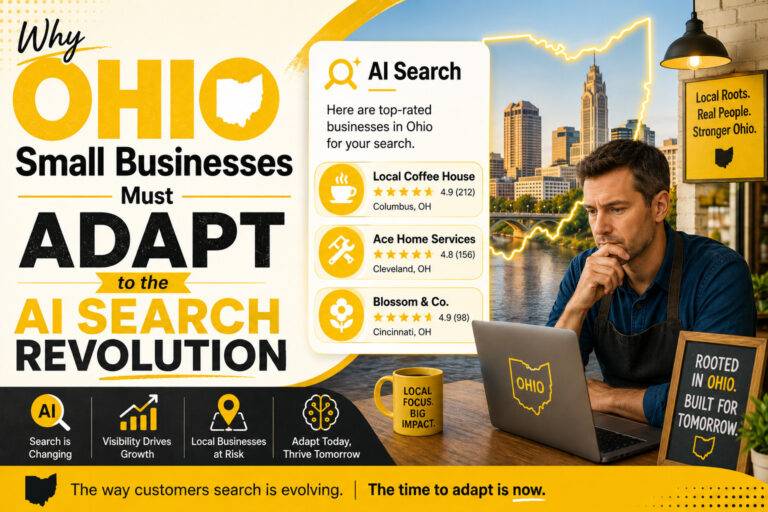
Something has changed in the way people find businesses in Ohio — and most small business owners have not noticed yet. A customer in Columbus who once typed “pizza near me” into Google is now asking an AI assistant, “Where can I get a late-night deep-dish pizza in Columbus that’s open past 11?” The answer they get is not a list of ten blue links. It is one confident recommendation, sometimes two. If your business is not positioned to show up in that answer, you may as well not exist for that customer. This is not a future concern — it is happening right now, in your city, in your industry.
What AI Search Actually Means for Ohio Businesses
AI search is not just a fancier version of what Google used to do. Tools like Google2019s AI Overviews, ChatGPT, Perplexity, and Gemini pull from a mix of structured data, reviews, website content, and authority signals to generate direct answers. When someone asks one of these tools for a plumber in Akron, a tax advisor in Cincinnati, or a landscaper in Dayton, the AI does not send them to a search results page first. It makes a choice and presents it as a recommendation.
For Ohio small businesses, this shift means that the rules of online visibility have changed. It is no longer enough to have a website and a few Google reviews. The AI needs to understand your business, trust your content, and see you as a credible, relevant option for local searches. That is where solid SEO services Ohio businesses invest in become the difference between being found and being invisible.
Why the Old SEO Playbook No Longer Works Alone
For years, ranking on page one of Google was the goal. Business owners focused on getting into the top ten results, maybe the map pack, and calling it done. That approach still matters, but it is not the whole picture anymore. Google2019s own Helpful Content System — updated multiple times over the past two years — now rewards content that genuinely answers real questions from real people, not content that was written to game an algorithm.
The businesses that are showing up in AI-generated answers share a few things in common. Their websites load fast. Their content actually helps people. Their Google Business Profiles are accurate and active. Their reviews are recent and specific. And they have built enough authority — through backlinks, citations, and consistent information — that AI systems trust them as a source. This is the new baseline.
How Ohio Businesses Are Losing Customers Without Knowing It
Here is what the data shows across local markets like Cleveland, Toledo, and Youngstown: a growing share of high-intent searches — the kind where someone is ready to buy, book, or call — are now going through AI-assisted results. These are not casual browsing searches. These are people who want to make a decision today. When AI search tools skip over your business, you are not losing a click. You are losing a customer who was ready to spend money.
A few of the most common reasons Ohio small businesses get passed over by AI search results:
- Their Google Business Profile has not been updated in months — missing hours, photos, or service descriptions.
- Their website content is thin, generic, or written without any real usefulness to the reader.
- They have inconsistent NAP (name, address, phone) data across directories, which confuses AI systems trying to verify legitimacy.
- Their reviews are either too few, too old, or lack specific detail that AI tools use as quality signals.
- They have not built any local authority — no mentions in regional publications, no relevant backlinks, no presence in local databases.
What Adapting to AI Search Actually Looks Like in Practice
1. Your Content Needs to Answer Real Questions
AI tools are trained to find content that genuinely helps people. That means your website pages, blog posts, and service descriptions need to answer the specific questions your Ohio customers are asking. Not keyword stuffing, not corporate speak — real answers to real questions. A roofing company in Mansfield should have content that answers, 2018How do I know if my roof needs replacing after a hailstorm?2019 A family dentist in Medina should have content that explains, 2018What should I expect at my first visit?2019 This is what Google2019s Helpful Content guidelines have been pushing for since 2022, and AI search has made it even more important.
2. Your Google Business Profile Is Your AI Calling Card
Your Google Business Profile is one of the primary sources AI tools pull from when generating local recommendations. An incomplete or stale profile is a serious disadvantage. Make sure your categories are specific and accurate, your hours reflect reality, your photos are recent, and your business description clearly explains what you do and who you serve. Post updates regularly. Answer every review — positive and negative. Treat it like a second website, because in AI search, it often functions as your first point of contact.
3. Reviews Are Now a Ranking Signal in a New Way
AI search tools read your reviews for context, not just for star ratings. A review that says, “Great service” tells an AI very little. A review like, “I called Be Found Next on a Tuesday morning with a last-minute project and they had a strategy ready by Thursday — completely changed our results,” tells AI exactly what kind of business you are, how quickly you respond, and what specific value you provide. Encourage your Ohio customers to leave detailed, specific reviews. That specificity is what gets picked up and referenced by AI systems.
4. Local Authority Still Matters — Maybe More Than Ever
Local Ohio news citing your business, regional directories listing it, and reputable local websites mentioning it still carry enormous weight. AI tools trust sources that other trusted sources also trust.
. A mention in the Dayton Daily News, a listing in the Ohio Chamber of Commerce directory, or a backlink from a respected local trade association all serve as trust signals. This is why link building and local PR remain core parts of strong SEO services Ohio business owners need — not just for traditional rankings, but for AI search visibility too.
The Ohio Business Landscape Is Competitive — And Getting More So
Ohio has a dense and diverse small business economy. From the manufacturing corridors of the Mahoning Valley to the tech-adjacent startups in Columbus and the service businesses scattered across smaller cities like Lima, Zanesville, and Findlay, competition for local customers is real. The businesses that move now — that build their AI search presence before the rest of their industry figures out what is happening — will have a significant head start. The ones who wait will spend the next few years trying to catch up.
The investment needed to adapt is not as large as most business owners assume. It does not require a complete website overhaul or a massive advertising budget. It requires consistent, strategic effort: better content, a maintained Google Business Profile, a steady stream of quality reviews, and a clean, authoritative presence across the web. This is exactly what professional SEO services Ohio businesses rely on to stay ahead.
What Be Found Next Does Differently
At Be Found Next, we work exclusively with the kind of results that actually move the needle for small and mid-sized businesses in Ohio. That means no cookie-cutter packages, no reports full of numbers that do not connect to real outcomes, and no strategies built for a version of search that no longer exists. We stay current with how Google, AI tools, and local search platforms are changing — because our clients’ visibility depends on it.
We have helped businesses across Ohio get into AI-generated answers, local map packs, and top organic positions for searches their customers are actually making. We do this by treating every business as unique — your industry, your city, your customer base, and your competition all shape the strategy we build. There is no template. There is no shortcut. There is just honest, expert work that gets results.
Ready to Show Up Where Your Ohio Customers Are Looking?
AI search is not slowing down. It is getting faster, more accurate, and more embedded into how people make buying decisions. Every month you wait is a month a competitor can use to get ahead of you in these results. The good news is that the fundamentals — helpful content, a strong local presence, and consistent authority signals — are things any Ohio business can build with the right guidance.
If you want to know exactly where your business stands in AI search today, and what it would take to improve your position, the first step is a conversation. No pressure, no hard sell — just a straight answer about where you are and what the path forward looks like.
