

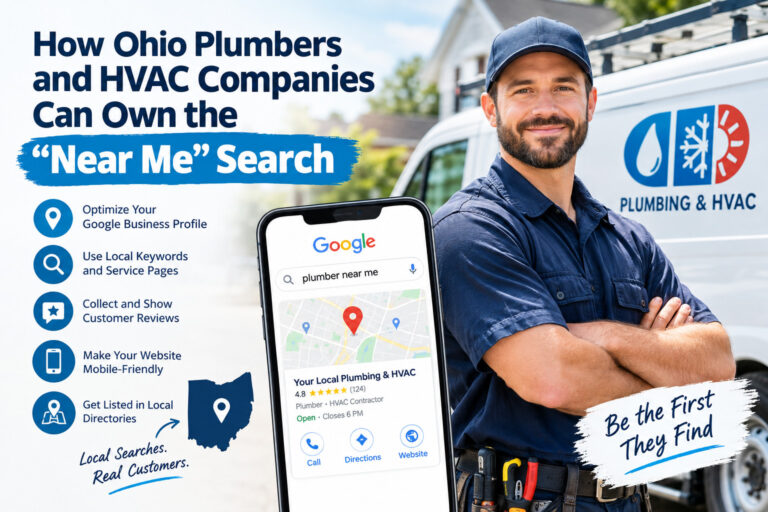
It is 6 a.m. in Columbus. The furnace quit overnight and the house is 58 degrees. Nobody is reading about brand history or comparing warranties. They pick up a phone, type “furnace repair near me,” and call one of the first three businesses on the screen. If yours is not in that group, the job goes to a competitor and you never find out it existed.
That is how most plumbing and HVAC work is won today. The good news is that “near me” results follow patterns you can influence. This guide explains what moves a local trade company into those top spots, based on the kind of work a digital marketing agency Ohio contractors hire handles every week. Nothing here needs a huge budget. It needs consistency and honest information.
Why “Near Me” Searches Decide Who Gets the Call
What people type when something breaks
Most emergency searches are short and urgent: “water heater leaking,” “AC not cooling,” “plumber open now.” Google reads the phone’s location and shows businesses close to that person. Your ad copy and slogan matter far less at that moment than three questions. Are you nearby? Are you open? Do other homeowners trust you?
Planned work behaves differently. Someone replacing a 20-year-old furnace will compare several companies over a week, read reviews, and check photos. You need to show up for both kinds of searcher, the panicked one and the careful one.
Why the map results matter more than your website
For local searches, Google usually shows a map with three businesses above the regular results. This is often called the local pack. Many calls come straight from that box without anyone visiting your website. The ranking depends mostly on three things: how close you are to the searcher, how well your profile matches the search, and how well known and trusted your business looks online.
You cannot move your shop closer to a customer. You can improve the other two, and that is where most of the work goes.
Step 1: Build a Google Business Profile That Earns the Click
Get the basics exactly right
Your Google Business Profile is the most valuable free asset you have. Start with the primary category. A company that does both plumbing and drain cleaning should choose the category that matches the money-making service, then add secondary categories for the rest. Pick “Plumber” or “HVAC contractor” only if that is truly your main work.
List every service you offer, with a short plain description of each. Add your service area by city or county, and be realistic. Claiming forty towns you rarely visit does not help you rank in them, and it can look careless.
Make sure your business name is your real name. Adding “Best Plumber Cleveland” to the name field is a fast route to a suspension, and Google has become stricter about it.
Photos that prove you show up
Stock photos tell a customer nothing. Real pictures do: your trucks with the logo, your technicians in uniform, a before-and-after of a water heater swap, a tidy work area. Upload new photos every few weeks. A profile with fresh, real images gives people confidence that the business is active and that a stranger is not going to arrive in an unmarked car.
Reviews: the part you control most
Reviews affect both ranking and whether a person picks you once they see you. Steady, recent reviews that mention specific services and towns tend to help most. Here is a simple process that works for busy crews:
- Ask at the end of the job, while the customer can see the problem is fixed.
- Send a text with a direct review link so it takes one tap.
- Train technicians to ask for reviews, and remind them why it matters.
- Reply to every review, good or bad, within a day or two and use a real human voice.
- Never buy reviews, offer discounts in exchange for them, or post fake ones. Google’s spam policies target this, and removed reviews or a suspended profile cost far more than the reviews were worth.
A calm, specific reply to a negative review often wins more trust than five easy compliments. Say what happened, what you will do about it, and how to reach you offline.
Step 2: Make Your Website Match the Search
One page per service, and one per major city
A single “Services” page that lists everything in a paragraph rarely ranks for anything. Build a separate page for each core job: furnace repair, AC installation, water heater replacement, drain cleaning, sewer line repair. If you serve several cities, create a genuine page for each of your main ones.
The important word is genuine. Copying the same text and swapping the city name is the kind of thin, repeated content Google’s recent updates target. A useful Toledo page mentions what Toledo homes usually have: older basements, hard water, homes with aging cast iron drain lines. Include a real job you completed there, a photo, and a review from a nearby customer.
Write for the homeowner, not for a robot
Google’s helpful content guidance is simple to summarize: write for people first, and show that you know the subject from real experience. A plumber has plenty of that. Explain what a failing water heater sounds like. Explain why a furnace short-cycles. Give a rough price range and what changes the price. Tell people when a repair is smarter than a replacement, even when replacement pays you more.
That kind of honesty is exactly what a searcher reads for. It also keeps people on the page, which tells Google the page did its job.
Speed, phone use, and a clear next step
Most “near me” searches happen on a phone. Test your site on your own phone with weak signal. If it takes more than a few seconds to load or the tap-to-call button is buried, you are losing calls that were already yours. Put your click-to-call button at the top of every page, keep forms short, and show your hours and service area without making people hunt for them.
Step 3: Keep Your Business Details Identical Everywhere
Your name, address, and phone number should read the same on your website, Google, Apple Maps, Bing, Yelp, Angi, the Better Business Bureau, and local chamber listings. Small differences such as “Street” versus “St.” or an old tracking number can confuse the systems that decide whether your business is real and stable.
Do an audit once a year. Search your business name and phone number, list every place it appears, and fix what is wrong. If you moved or changed numbers, this step matters even more, since old listings keep sending people to the wrong place.
Local links help too. Sponsoring a youth baseball team, joining the local chamber, or working with a nearby supplier often gets your name on a real local website. Those mentions carry more weight than a pile of random directory links.
Step 4: Social Media Marketing That Supports Local Search
What social media marketing can and cannot do
Let’s be honest about the role. A Facebook post will not rank you in the map pack by itself. What social media marketing ohio does well is build familiarity. When a homeowner has seen your truck in a neighbor’s post, watched a short video of your tech explaining a sump pump, and then has an emergency, your name is the one they trust. That recognition turns into more clicks on your listing and more brand searches, and both are healthy signals.
What to post
Skip generic quotes and stock graphics. Post what your crew already does:
Short clips of a repair, a technician explaining a common problem in thirty seconds, a completed install with the homeowner’s permission, or a quick seasonal reminder like “Here’s how to check your sump pump before the spring rains.” Post in your service area, tag the town, and answer comments and messages fast.
Community groups on Facebook and Nextdoor matter a lot for trades. Be a useful neighbor there. Answer questions honestly without pushing a sales pitch, and let your work speak. Neighbors recommend plumbers to each other constantly, and a solid social media marketing routine puts you in those conversations.
Step 5: Plan Around Ohio’s Seasons
Ohio’s weather drives demand, so your marketing should follow it instead of running the same message all year.
In late summer and early fall, promote furnace tune-ups before the first cold snap. Once temperatures drop, emergency heating repair is what people search for, so your profile, hours, and after-hours message need to be correct. Frozen and burst pipes spike during January cold. In spring, sump pumps, drain backups, and AC service prep take over. In June through August, heat waves send cooling searches through the roof, and companies that answer quickly win.
Update your Google profile with seasonal posts, adjust your website’s homepage message, and line up your social media marketing around the same calendar. If you prepare a month ahead, you are ready when demand arrives rather than scrambling after it.
Step 6: Track Calls, Not Just Clicks
A lot of reports show impressions and website visits, but a plumber needs to know how many calls came in and how many became jobs. Set up call tracking so you can see which source produced each call: Google profile, website, or ads. Track booked jobs and revenue per source when you can.
Look at your Google Business Profile insights for calls, direction requests, and searches that showed your listing. Ask new customers how they found you and write it down. Within a few months, patterns appear. You may learn that water heater pages bring in your best jobs, or that one town is quietly sending most of your leads. Spend more where the money actually comes from.
What Recent Google Updates Mean for Trade Companies
Google has spent the last couple of years tightening its stance on low-value pages. Its core updates and spam policies push down content made mainly to rank instead of to help, and they push up pages written by people who know the work. For a plumbing or HVAC company, the takeaway is practical.
First, mass-produced city pages with swapped-in place names are a risk. Fewer, better pages beat hundreds of thin ones. Second, fake or incentivized reviews and keyword-stuffed business names can get you demoted or removed. Third, Google increasingly answers questions directly in search results, including summaries at the top of the page. To be cited or clicked, your content needs original detail, such as real prices, real photos, and real experience, that a generic summary cannot supply.
You do not need tricks for any of this. Being specific, accurate, and useful is the strategy, and trade businesses are well placed to do it since the knowledge already sits in your technicians’ heads.
Common Mistakes That Cost Ohio Contractors Calls
Some problems show up again and again. Companies leave their Google profile unclaimed or unverified. They use a tracking number that differs from the number on their site. They never answer reviews. They list services they do not offer, then get calls they cannot take. They let the website sit untouched for three years. They also judge marketing by how it looks instead of by the phone ringing.
One more: missing calls. Search visibility means nothing if the phone rings out at 7 p.m. in January. Use an answering service or a call-forwarding setup for after hours, because the customer with no heat will simply call the next name on the list.
Choosing the Right Help
Many owners try to handle this alone for a while, and a lot of it can be done in-house. The profile, the review requests, and the honest service pages are all within reach. When time runs short, or results stall, outside help makes sense. When you compare a digital marketing agency Ohio businesses can vouch for, ask a few direct questions:
Do they work with local service companies, and can they show real call and booking results rather than just rankings? Will you own your Google profile, website, and ad accounts? Do they explain their work in plain language? Do they avoid promising a number one ranking? Nobody can promise that honestly.
A good partner will spend the first conversation asking about your service area, your best-margin jobs, and your capacity, not pitching packages.
How Be Found Next Works With Trade Companies
Be Found Next is a digital marketing agency Ohio plumbers and HVAC companies can work with when they want local search and social handled by people who understand service businesses. We start with an audit of your Google profile, your website, your listings, and how you show up for “near me” searches in your towns. From there we build a plan around your season, your best jobs, and your crew’s capacity, then report on calls and booked work instead of vanity numbers.
Our work covers local search, review systems, website pages that answer real customer questions, and social media marketing built from your own jobs and your own team. If you would rather have someone look at your setup first, the contact form on our website takes about two minutes, and you can pick a time that suits you.
Putting It Together
Owning “near me” search is not one big move. It is a set of small, steady habits: a complete and honest Google profile, real reviews that you answer, service pages written for homeowners, consistent details across the web, local social posts that make your name familiar, and a calendar that follows Ohio’s weather. Add call tracking so you can see what is working, and answer the phone when it rings.
The companies that win these searches are rarely the ones with the flashiest ads. They are the ones that look reliable, show proof, and respond fast. That gap between you and a competitor with the same skills is often just marketing effort, and it is fixable.
If you want a second set of eyes on your local presence, working with a digital marketing agency Ohio trades trust can shorten the learning curve considerably.
Ready to get more calls from people in your area? Book your free local search review through the contact page on the Be Found Next website, and let’s look at where your business stands today.
