

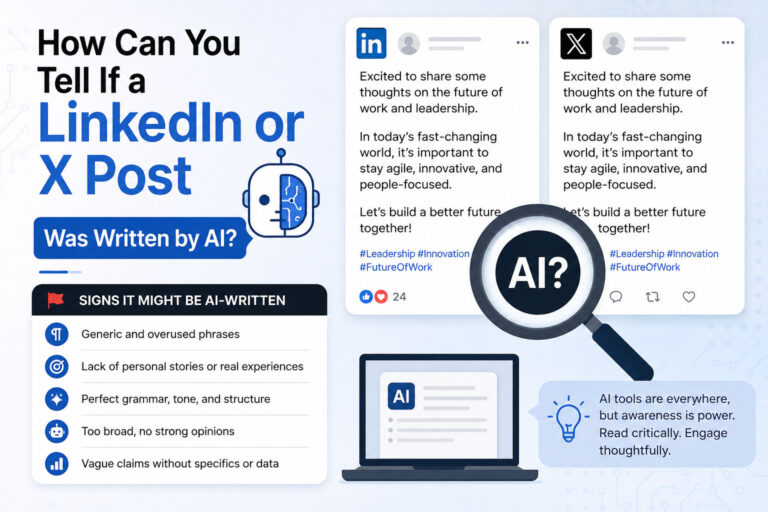
You can usually tell a LinkedIn or X post was written by AI when it uses generic transition phrases, overly balanced sentence structure, repeated buzzwords, no specific numbers or names, and a tone that sounds polished but says very little. Posts written by real people tend to include small details, opinions, imperfect phrasing, and references to actual events or people — things AI tools rarely add on their own.
If you run a business page or a personal brand account, this question matters more than it used to. Readers are getting tired of posts that sound like they came from a template, and platforms are starting to notice too. Below, we’ll walk through the specific patterns that give away AI writing, why this shift is happening right now, and what it means if you’re handling social media marketing Ohio businesses depend on to bring in real customers.
Why This Question Is Coming Up So Much Right Now
A few years ago, nobody thought twice about whether a LinkedIn post was human-written. Now it’s a common topic of conversation, and for good reason. Recent industry analysis found that a large share of long-form LinkedIn posts and a meaningful portion of X posts show clear signs of being fully generated by AI tools. People noticed. Engagement on obviously AI-written posts has started to drop, while rougher, more personal posts are getting more comments, shares, and trust.
This isn’t just a social media trend — it connects directly to how search engines evaluate content. Recent updates from Google have put more weight on content that shows real experience, a clear point of view, and information that couldn’t have been pulled together by a machine with no direct knowledge of the topic. That applies to blog posts, but it also applies to how people judge social content and, by extension, the businesses behind it. A brand account full of hollow AI posts sends a signal, and it’s not the one most businesses want to send.
Read More:- How Ohio Businesses with Multiple Locations Can Dominate Google and AI Search
Common Signs a LinkedIn Post Was Written by AI
LinkedIn posts written by AI tools tend to follow a familiar shape, even when the topic changes. Once you know what to look for, the pattern becomes easy to spot.
The Post Starts With a Broad, Vague Hook
AI-generated posts often open with a sweeping statement about an industry, a trend, or “the way things are changing.” It sounds confident but doesn’t actually say anything specific. A real person writing about their week is more likely to open with something concrete — a client conversation, a number, a mistake they made, or a moment that actually happened.
The Structure Is Too Balanced
AI tools like to organize posts into neat three-part lists, matching sentence lengths, and evenly spaced line breaks. It reads cleanly, almost too cleanly. Real writing has rhythm that varies — short sentences next to longer ones, a stray thought, a sentence that trails off. When every line is roughly the same length and every point gets equal weight, that evenness is often a tell.
Buzzwords Replace Actual Information
Certain words show up constantly in AI-generated business writing: words that sound impressive but don’t commit to anything specific. Watch for posts that talk about “driving results” or “unlocking growth” without ever naming a client, a number, a tool, or a method. If you removed the buzzwords, would there be any real information left? If not, that’s a strong signal.
There’s No Personal Risk or Opinion
People who write their own posts usually say something a little risky — an unpopular opinion, a criticism of a common practice, or an admission that something didn’t work. AI-generated posts tend to avoid taking a side. They stay safe, agreeable, and vague on purpose, because the tool has no actual stake in the topic.
The Comments Section Feels Disconnected From the Post
This one takes a bit more digging, but it’s reliable. If the person almost never replies to their own comments, uses generic responses like “Great point, thanks for sharing!” on every single comment, or seems to not actually know the details of what they posted, that mismatch is worth noticing.
Common Signs an X Post Was Written by AI
X posts are shorter, so the signs show up a little differently, but they’re still there once you’re paying attention.
- Perfect grammar in a format built for casual writing. X threads and short posts are usually where people are looser with punctuation and phrasing. A thread with flawless grammar, consistent capitalization, and zero typos across dozens of posts is unusual for a human account posting daily.
- Threads that repeat the same idea in slightly different words. AI tools sometimes pad out threads by restating a point three or four times with minor wording changes instead of adding new information.
- No reaction to real-time events. Human accounts on X tend to reference something happening that day — a news story, a reply to another post, a joke about something trending. Fully AI-generated accounts often post in a vacuum, disconnected from the actual conversation happening on the platform that day.
- Replies that don’t match the tone of the original post. If the main posts sound like one voice and the replies sound like a completely different one, that inconsistency is often a sign that different tools (or no human at all) are behind different parts of the account.
- Hashtag stuffing at the end of short posts. This habit has mostly disappeared from real human posting on X, but AI-generated content still does it out of habit, tacking on several hashtags that don’t match how people actually write on the platform anymore.
Why People React So Strongly Once They Notice
Once someone catches on that a post was written by AI, their trust in the entire account tends to drop, not just their opinion of that one post. This reaction shows up across age groups and industries, and it happens fast. Part of the reason is that people don’t mind AI tools existing — they mind feeling like a conversation was one-sided from the start, with no actual human paying attention on the other end.
There’s also a fatigue factor. Feeds are crowded with content that sounds interchangeable, and readers have started developing a kind of pattern recognition for it without even realizing it consciously. A post might get a quick scroll-past reaction of “this sounds fake” before the reader can even explain why. That instinct is usually built from months of seeing the same sentence structures, the same safe conclusions, and the same buzzwords repeated across hundreds of different accounts.
For a business, this matters because trust on social platforms tends to transfer directly to trust in the brand itself. If a company’s posts feel hollow, that impression follows the business into other decisions a potential customer makes — whether to call, whether to book, whether to believe a five-star review is real. None of this means every post has to be a personal essay. It means the posts that do go out need to actually sound like they came from someone who works there.
What This Means for Businesses Doing Social Media Marketing in Ohio
For local businesses, this shift changes the calculation. A company running social media marketing Ohio audiences will actually trust needs posts that read like they came from a real person on the team, not a content farm. Ohio consumers, like most people right now, are quicker than ever to scroll past anything that feels generic, and slower to trust brand accounts that never sound like they’re run by an actual human being.
That doesn’t mean AI tools are off the table entirely. Plenty of businesses use them for research, first drafts, or organizing ideas. The problem starts when a post goes out exactly as the tool wrote it, with no edits, no specific details added, and no actual voice behind it. Good social media marketing Ohio business owners can count on today involves using AI as a starting point at most, then adding the details a real person would know: a customer’s name (with permission), a specific number, an actual result, a personal reaction to something that happened.
Search engines are watching this pattern too. Google’s recent guidance has repeatedly pointed toward rewarding content that demonstrates direct experience and penalizing content that reads as mass-produced or interchangeable with dozens of other pages saying the same thing. This applies to blog content most directly, but the same principle is spreading into how platforms and audiences judge social posts. Businesses thttps://befoundnext.com/hat treat social media marketing Ohio customers respond to as a place for real commentary, not filler content, are the ones building trust that actually lasts.
How Be Found Next Approaches This Differently
Be Found Next works with Ohio businesses that want their social presence to sound like an actual person is behind it, because that’s what gets read, trusted, and remembered. That means writing posts with real specifics, real opinions, and a voice that matches how the business actually talks to customers — not a version smoothed out until it sounds like everyone else’s feed.
Part of that approach means checking every post against a simple question: could this have been written about any business, anywhere, or does it clearly belong to this one? If a post could be copied onto a competitor’s page with no changes, it’s not doing its job.
This also shows up in how content gets planned, not just how it gets written. A calendar built entirely around generic industry tips will always drift toward the same AI-sounding tone, because there’s nothing specific to anchor it to. A calendar built around actual events — a project the team finished, a question a customer asked last week, a mistake worth talking about honestly — naturally avoids that trap, because there’s no way to write those posts without real information.
A Quick Checklist Before You Publish
Before a LinkedIn or X post goes live, it helps to run through a short list:
- Does the post include a specific detail — a name, number, date, or real event?
- Is there an opinion or a point of view that not everyone would agree with?
- Would this post make sense coming from any other business, or does it clearly belong to yours?
- Are the sentence lengths varied, or does everything read at the same pace?
- Did a real person read this out loud before posting it?
If a post fails most of these, it’s worth a second look before it goes out under your name.
The Bottom Line
Spotting AI-written posts comes down to noticing what’s missing: specific details, a real opinion, and small imperfections that only a person would leave in. As platforms and search engines keep rewarding content that shows genuine experience, businesses that keep a human voice behind their social media marketing Ohio audiences are seeing more consistent engagement, more trust, and better long-term results than accounts that rely on generic, machine-smoothed posts.
None of this requires abandoning AI tools altogether or turning every post into a personal diary entry. It just means checking each piece of content against a basic standard: does this sound like it came from a person who actually knows the business, or could it have been written by anyone about anything? Businesses that keep asking that question tend to build accounts people actually want to follow, instead of ones that just get scrolled past.
If you want a second set of eyes on how your business sounds online right now, Be Found Next puts together a short review of your current social presence and shows you exactly where it reads like a template instead of your actual brand voice. Send us a message through our website to get that review started.
