

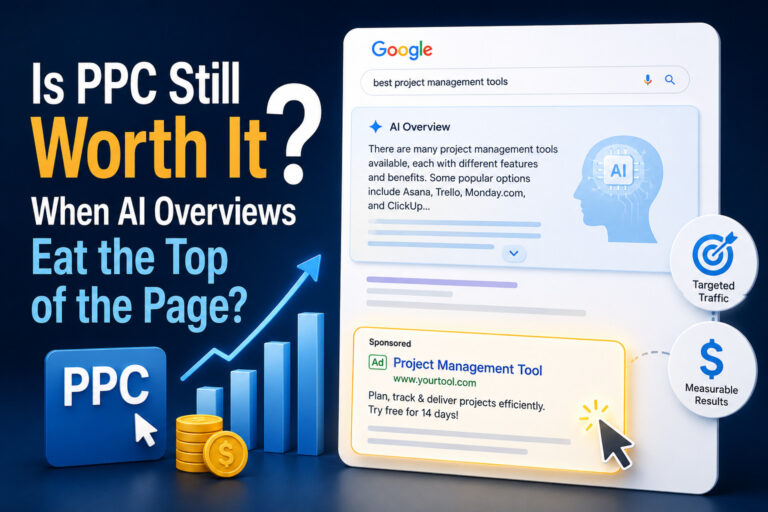
Open Google right now and search for almost any local service, and the first thing you see isn’t a website. It’s a paragraph. Google’s AI Overview reads the web for you, summarizes it, and hands you an answer before you’ve scrolled past the fold. The ads are still there, sitting right below or beside it, but the page feels different than it did even a year ago. So the question business owners keep asking is a fair one: if people are getting their answers without clicking anything, is paying for clicks still a smart use of a marketing budget?
The short answer is yes, but not in the same way it worked in 2022. The longer answer needs some unpacking, so let’s walk through what’s actually happening on the results page, what the data says about who still clicks, and how paid search fits next to organic visibility and social media marketing in a plan that actually holds up under this year’s Google updates.
What AI Overviews Changed
AI Overviews sit at the top of many search results and pull together information from several sources into one written answer. For simple, factual questions — store hours, what a service costs on average, the difference between two products — a lot of users read the summary and move on. No click happens. No ad gets seen unless it happens to be placed near or inside that summary.
That’s the part that scares advertisers. But it’s worth separating two very different kinds of searches. Informational searches, like “what is a PPC marketing agency” or “how does teeth whitening work,” are the ones AI Overviews satisfy most often, and they were rarely converting into paying customers anyway. Transactional and local searches, like “dentist near me accepting new patients,” “book a marketing consultation,” or a query as specific as “PPC Marketing Agency Ohio,” still push users toward a website, a form, or a phone call, because the AI answer can’t actually complete the transaction for them.
Ad placements on transactional searches haven’t disappeared. They’ve moved slightly, and the competition for that space has gotten tighter, but the intent behind those searches hasn’t changed. Someone typing PPC Marketing Agency Ohio doesn’t want a dictionary answer. They want someone to hire.
The Truth About Zero-Click Search
There’s a lot of noise online claiming that clicks are dead across the board, and that’s simply not what the data shows. Zero-click behavior is heavily concentrated in searches that never had commercial intent in the first place. Meanwhile, searches with buying intent are converting at a similar or even better rate than before, mostly because the people who do click past an AI Overview have already ruled out the easy answer and are actively comparing options.
That distinction matters because it changes what “worth it” actually means. PPC was never meant to capture every search — it was meant to capture the searches that lead to revenue. If AI Overviews are filtering out window-shoppers and leaving behind people ready to act, the traffic reaching your site through paid ads may be smaller but more qualified than it used to be.
Where PPC Still Wins
Paid search still does a few things that nothing else on the results page can replicate:
- Speed. Organic rankings and AI citation both take time to build, but a PPC campaign can put your business in front of a ready-to-buy customer this afternoon. That matters most for service businesses with open appointment slots, seasonal promotions, or a new location that needs visibility fast.
- Control. You choose the exact phrase you show up for, the offer you lead with, and the page someone lands on. AI Overviews decide on their own what to summarize and which sources to cite — you have far less say in how your business gets represented there.
- Local intent. When someone searches with a city or neighborhood attached — the kind of query a PPC Marketing Agency Ohio client cares about most — Google still shows a mix of the local map pack, organic listings, and paid ads together. AI Overviews rarely dominate that layout the way they do on broad informational searches.
PPC Needs Social Media Marketing
Here’s the part a lot of businesses miss: AI Overviews pull from sources that already have visibility and trust signals across the web, not just from a website’s own content. A brand that only exists on its homepage has less material for AI systems to reference than a brand with an active presence across multiple platforms.
This is where social media marketing earns its place in the same conversation as paid search. A steady stream of posts, reviews, and engagement builds the kind of brand recognition that search engines and AI tools increasingly reward. When someone sees your business mentioned on Instagram, then later searches your name on Google, that combination of familiarity and paid visibility tends to convert faster than either channel working alone. It also gives you a second place to reach the exact users who skimmed an AI Overview and moved on without clicking anything — you get another chance to earn their attention later, on a different platform, without paying for another search click. Brand mentions, tagged posts, and customer replies all add up to the kind of activity that platforms and search engines alike read as a sign of a real, active business.
Businesses that treat paid search and organic content as separate line items with separate goals usually end up spending more to get less. The two work better as one connected effort: paid search catches people at the moment of decision, while a steady online presence keeps the brand visible in between those moments. A prospective customer might see a post one week, hear the business name mentioned by a friend the next, and only then run the search that finally triggers a click on the ad. Paid search rarely gets credit for that earlier groundwork, but it benefits from it every time.
A Real Campaign Example
Numbers make this easier to picture than theory does. Say a local service business is running a modest paid search budget and split-testing two types of keywords: broad questions like “how much does X cost” and specific buying terms like “book X in [city].” Over a few months, the broad terms almost always show a dip in click-through rate as AI Overviews answer the question directly on the page. The specific buying terms hold steady or even improve slightly, because the person searching them has already decided they want to hire someone and is now comparing who to hire.
That pattern repeats across most local service categories — legal, medical, home services, and yes, marketing itself. It’s the reason a smart account manager doesn’t look at a falling overall click-through rate and panic. The businesses that hold up best in this kind of test are usually the ones already running a steady social media marketing effort alongside paid search, since a familiar brand name in the results tends to earn the click even when an AI Overview is sitting right above it. The right question isn’t “are clicks down,” it’s “are the clicks that remain turning into paying customers.
The Core Update Factor
Google’s core updates this year have leaned further into rewarding pages that answer questions clearly and directly, the same qualities AI Overviews look for when deciding what to summarize. That has two effects on paid strategy.
First, landing pages tied to PPC campaigns need to hold up on their own merit now, not just as an ad destination. A rushed page with thin content and no real answers hurts quality score and conversion rate alike. Second, the businesses showing up inside AI-generated answers are often the same ones with strong organic and social signals feeding into that summary — which means paid campaigns perform better when they’re built on top of a site that already has some organic authority, not as a replacement for it.
None of this means PPC is losing ground to organic or to AI search. It means the channels are becoming more dependent on each other than they used to be.
Pause or Adjust?
Pausing PPC entirely because of AI Overviews is usually the wrong move, especially for a local or service-based business where every new customer has real, ongoing value. What tends to work better is adjusting where the budget goes:
- Shift spend toward transactional, high-intent keywords rather than broad informational terms AI Overviews already answer well.
- Make sure landing pages give a real, direct answer above the fold instead of a generic pitch.
- Track calls, form submissions, and booked appointments, not just clicks, since a smaller number of serious inquiries can outperform a larger number of casual ones.
- Keep a consistent posting and engagement schedule running alongside paid search so your brand shows up in more than one place at once.
A PPC Marketing Agency Ohio business owner is really asking, does this still bring in customers, and for most local service categories, the answer is still yes — the strategy just needs to account for a search page that behaves differently than it did two years ago.
Making the Right Call
Every industry and every local market reacts a little differently to these shifts, which is exactly why guessing at a budget split rarely works out. Some businesses will get more value from doubling down on local paid search this year. Others will see better returns from putting more weight behind organic content and social media marketing while trimming paid spend on the terms AI Overviews already handle well.
A few questions are worth sitting with before touching next month’s budget:
- Which of your current keywords are informational, and which ones actually lead to a booked job or a signed client?
- Do your landing pages answer the searcher’s question in the first few lines, or do they lead with a pitch before getting to the point?
- Is your business showing up anywhere outside of Google — social platforms, review sites, local directories — in a way that would give an AI system something to cite you for?
- Are you tracking calls and form fills, or just clicks and impressions?
None of these questions have a universal answer, and that’s really the point. A business in a competitive market with several similar competitors running ads needs a different mix than a business with almost no local competition at all. A service with a long sales cycle, like a remodel or a legal case, will lean more heavily on retargeting and content than a business selling something people decide on the same day.
If you’ve been staring at your ad numbers wondering whether the drop in clicks means something is broken, it’s worth having someone actually look at the data before pulling back the budget. Search behavior has shifted enough in the past year that decisions based on last year’s playbook can quietly cost a business real revenue, and most owners don’t have the hours in a week to track every algorithm change while also running the business itself.
The team at Be Found Next spends time in accounts like this every week, and a short conversation about what’s happening in your specific market — and what a smart next step looks like — costs nothing to have. Get in touch with Be Found Next if you’d rather have that conversation than keep guessing where your ad budget should go next.
