

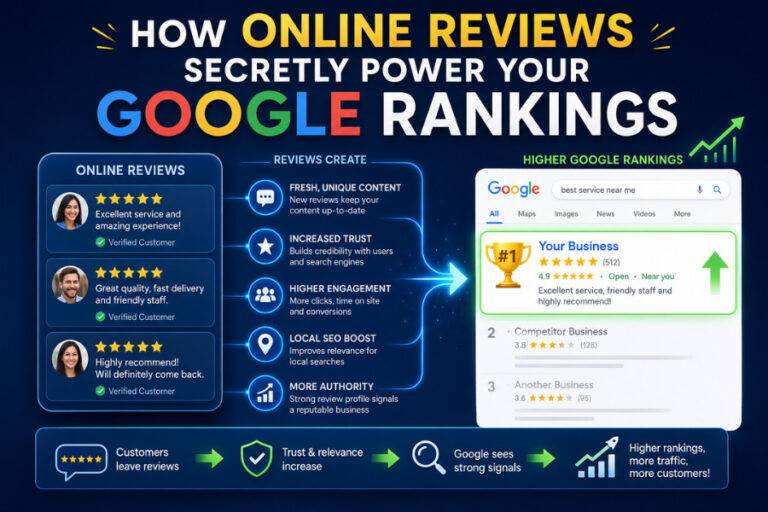
Most business owners think of online reviews as something customers leave after a transaction — a form of social proof that either helps or hurts their reputation. That is part of the picture. But what very few business owners realise is that those same reviews are actively shaping where their business appears in Google search results. Not just on Google Maps. Not just in the local pack. Everywhere. Understanding how this works is one of the most practical things any Ohio small business can do right now to get more visibility without spending more on advertising.
Why Google Treats Reviews as a Ranking Signal
Google’s core job is to give searchers the most relevant, trustworthy result for their query. When someone searches for a plumber in Cincinnati or an accountant in Columbus, Google needs to decide which businesses are the most credible and useful options to show. Reviews are one of the clearest signals it has. A business with a high volume of recent, specific, and positive reviews is telling Google: real people have used this business, they had a real experience, and they took the time to write about it. That is a trust signal that no amount of keyword placement can fully replace.
Google’s own documentation confirms that review scores and review count both factor into local ranking. But the more recent understanding — backed by consistent observations across industries — is that review quality and keyword content inside reviews also play a role. When a customer writes, “Best family dentist in Akron, fast appointment and very gentle with my kids,” that review contains location signals, service signals, and specificity that Google’s systems can read and use.
The Connection Between Reviews and the Local Pack
This is why working with a strong local SEO company Ohio businesses trust is so important — because managing review signals is not just about asking customers to leave feedback. It is a structured process of generating, monitoring, responding to, and optimising reviews in a way that reinforces your local prominence over time.
What Makes a Review Valuable to Google
Recency matters more than most people think
A business that received 150 reviews in 2021 and has had nothing since is in a weaker position than a business that has received 30 reviews in the past six months. Google interprets a steady stream of recent reviews as a sign that the business is active, relevant, and currently serving customers. Stale reviews suggest a business that may have changed, closed, or declined in quality. If your last review was eight months ago, that gap is costing you ranking power right now.
Specificity signals trust to both Google and customers
Generic five-star reviews with no text content carry far less weight than detailed ones. A review that mentions the specific service received, the location, the staff member’s name, or the outcome of the experience gives Google more usable data. It also performs better with human readers, who are far more likely to trust a review that describes a real scenario over one that just says “Great service!” Encouraging your customers to be specific is one of the simplest ways to improve both your search performance and your conversion rate.
Review responses are part of the signal too
How you respond to reviews — both positive and negative — is visible to Google and to every future customer who reads your listing. Responding to reviews regularly signals that the business is active and engaged. A well-written response to a negative review can actually strengthen trust by showing that you take customer experience seriously. Businesses that never respond to reviews are missing one of the easiest local SEO actions available to them.
The Most Common Review Mistakes Ohio Businesses Make
After working with small businesses across Ohio, the same patterns come up repeatedly. These are the review-related mistakes that are quietly holding local businesses back from the rankings they deserve:
- Asking for reviews only once, usually right after launch, then stopping entirely — which causes review volume to peak and then stagnate.
- Using third-party review platforms exclusively while neglecting Google Business Profile, which carries the most direct ranking weight for local search.
- Never responding to negative reviews — or worse, responding defensively in a way that damages trust rather than rebuilding it.
- Sending generic review request messages that give customers no guidance on what to write, resulting in low-detail responses that carry limited SEO value.
- Treating a review strategy as a one-time setup rather than an ongoing part of operations — which means falling behind competitors who are consistently building their review profile.
Explore More:- Why Ohio Small Businesses Must Adapt to the AI Search Revolution
How to Build a Review Strategy That Actually Moves Rankings
Make the ask part of your process, not an afterthought
The businesses that consistently generate reviews do not leave it to chance. They have a moment in every customer interaction — after a job is completed, after a positive check-in, after a purchase — where a review request is a natural next step. That could be a follow-up text, an email, a card left with a QR code, or a simple in-person ask. What matters is consistency. One request per customer, well-timed, makes all the difference.
Guide customers toward useful content in their reviews
You cannot tell customers what to write, but you can give them a prompt that leads to better content. Something as simple as: “If you have a moment, we would really appreciate a Google review — even just mentioning the service you used and what your experience was like helps other customers know what to expect.” That framing encourages specificity without scripting the response. The result is reviews that contain real service names, real locations, and real detail — exactly what Google values most.
Connect your review strategy to your broader SEO work
Reviews do not work in isolation. They work best when they are part of a broader local SEO effort that also includes a well-maintained Google Business Profile, consistent citation data across directories, strong on-page content, and a fast, mobile-friendly website. When all of these signals are aligned, Google has far more reason to rank your business above competitors who are only getting one or two pieces right. This is the kind of joined-up approach that a knowledgeable local SEO company Ohio small businesses need to stay competitive in their markets.
What Google’s 2024 and 2025 Updates Mean for Review Signals
Google’s core updates over the past two years have consistently moved in one direction: rewarding businesses and websites that demonstrate genuine real-world credibility. The Helpful Content system, the spam updates, and the local search quality changes have all reinforced the same idea — Google wants to surface businesses that real people have real experiences with. Fake reviews, review gating, and incentivised reviews have all become harder to game and riskier to attempt. The reward is for businesses that build an authentic review profile over time through legitimate customer relationships.
What this means in practice is that slow, steady, consistent review building now outperforms any shortcut. If your business in Cleveland, Dayton, Toledo, or anywhere else in Ohio has been sitting on a flat review profile for the past year, you are losing ground every month to competitors who have made this a priority. The good news is that catching up is very achievable with the right process in place — and the results compound quickly once momentum builds.
Negative Reviews Are Not the End of the World
One concern that holds many business owners back from actively seeking reviews is the fear of negative ones. This is understandable, but the data tells a more reassuring story. Businesses with a small percentage of critical reviews — and professional, thoughtful responses to them — consistently outperform businesses with suspiciously perfect ratings that have gone unanswered. Consumers trust a 4.6 rating with 180 reviews and a handful of engaged responses far more than a 5.0 rating with 11 reviews and no activity. Google’s systems appear to reflect this same logic.
When you receive a negative review, respond within 24 to 48 hours. Acknowledge the experience without being defensive. Offer to make it right offline. Keep the response short and professional. You are not writing for the person who left the review — you are writing for every future customer who reads it. Done well, a thoughtful response to a critical review can actually strengthen your brand more than a glowing five-star one.
Ready to Make Your Reviews Work Harder for Your Ohio Business?
Online reviews are one of the most underused ranking tools available to Ohio small businesses — and one of the most affordable to get right. If your review profile has been sitting still while your competitors build theirs, now is a good time to change that. The businesses showing up in local search results today are not necessarily the biggest or the oldest. They are the ones with the most consistent signals of real-world credibility — and reviews are a major part of that picture.
If you want a straight answer about where your business stands in local search right now — and a clear plan for improving it — the first step is a conversation with Be Found Next. No jargon, no hard sell, just an honest assessment of what is working and what is not.
Frequently Asked Questions
Do Google reviews directly affect my search ranking?
Yes. Google has confirmed that review scores and review volume are factors in local search ranking. Beyond the official confirmation, the consistent real-world pattern is clear: businesses with higher review counts, better ratings, and more recent activity rank higher in the local pack and organic local results than direct competitors with weaker review profiles.
How many reviews do I need to rank well?
There is no fixed number. What matters most is being competitive within your specific market and category. In a smaller Ohio city, 40 to 60 recent, high-quality reviews may be enough to rank strongly. In a more competitive urban market, you may need significantly more. The key is benchmarking against the businesses currently ranking at the top of your target searches and working toward a stronger overall profile.
Can I ask customers to leave reviews?
Yes, and you should. Google’s guidelines allow businesses to ask customers for reviews. What is not permitted is offering incentives in exchange for reviews, asking only customers you know will leave positive feedback (known as review gating), or using fake or purchased reviews. A straightforward, honest request — by email, text, or in person — is completely within the rules and is the most effective way to build your profile.
Does responding to reviews help with SEO?
Yes. Responding to reviews signals to Google that the business is active and engaged, which contributes to your overall prominence score in local search. Consistent responses also improve the experience for every future customer who reads your listing before deciding whether to contact you.
What should I do about fake negative reviews?
If you believe a review is fake — from someone who was never a customer, or posted by a competitor — you can flag it for removal through Google Business Profile. Provide as much supporting detail as possible when you report it. While Google’s review removal process can be slow, persistent reporting does result in removals for reviews that clearly violate their policies. In the meantime, respond professionally to the review as if other potential customers are reading it — because they are.
Is a local SEO company worth it for a small Ohio business?
For most small businesses competing in a local Ohio market, yes. The combination of Google Business Profile management, review strategy, citation building, on-page optimisation, and content strategy is difficult to execute well without dedicated expertise and time. A good local SEO company Ohio businesses work with will be transparent about what they are doing, why, and what results to expect — and the return on investment from consistent local search visibility is measurable and significant.
